
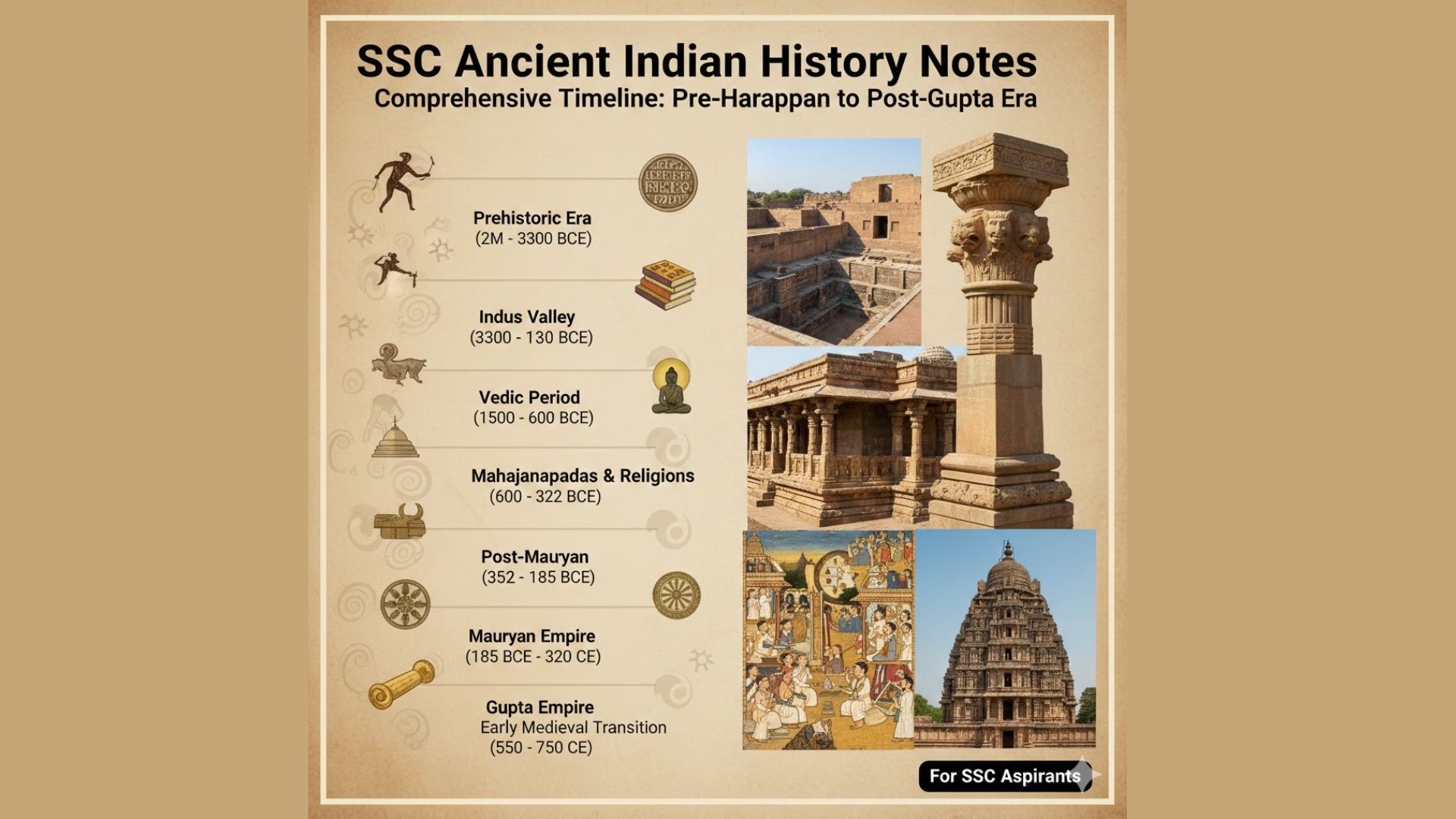
Comprehensive Timeline of Ancient Indian History: Pre-Harappan to the Post-Gupta Era
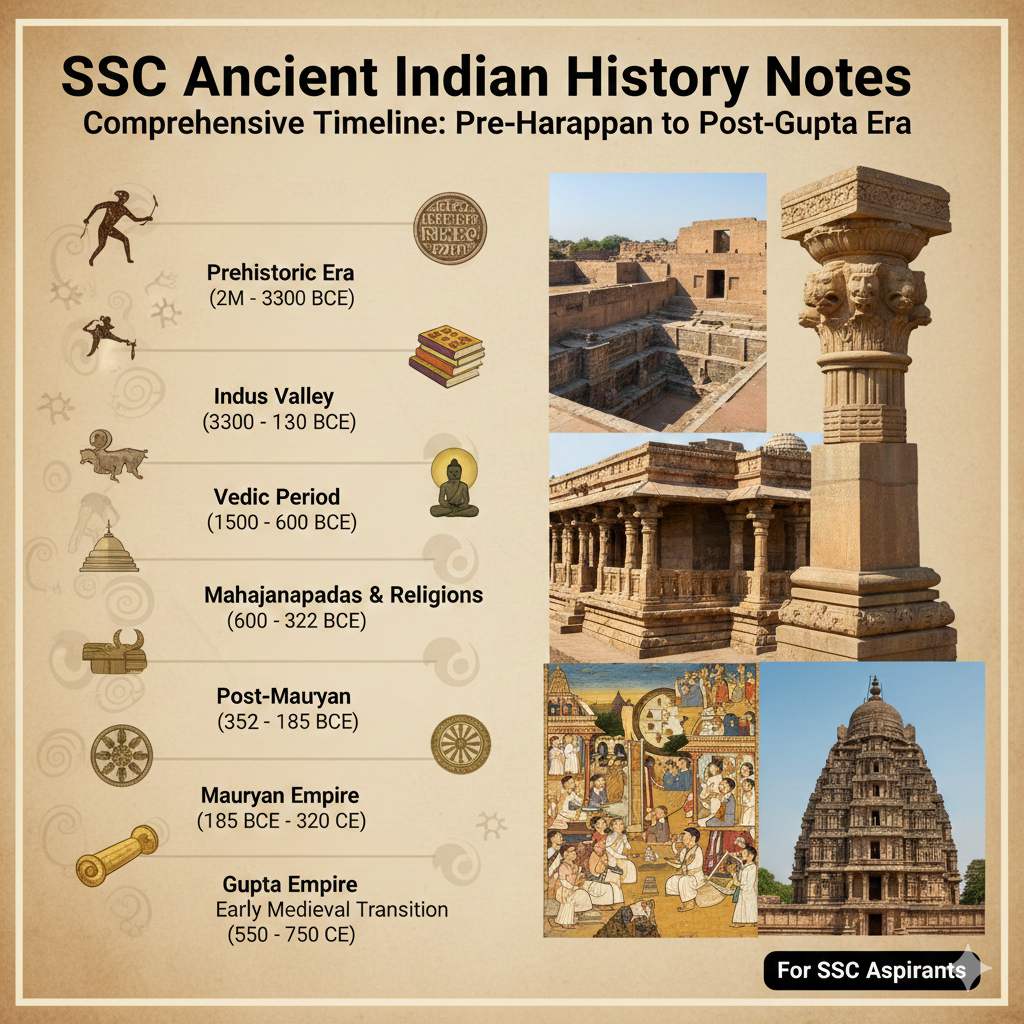
1. Prehistoric Era (c. 2 Million BCE – 3300 BCE)
This period marks the evolution of early humans and the transition from hunting-gathering to settled farming.
-
Palaeolithic Period (c. 2 Million – 10,000 BCE): Use of rough stone tools; discovery of fire. Key sites include Bhimbetka (rock shelters) and the Narmada Valley.
-
Mesolithic Period (c. 10,000 – 8,000 BCE): Use of microliths (small stone tools); beginning of animal domestication.
-
Neolithic Period (c. 8,000 – 3,300 BCE): Introduction of agriculture, polished stone tools, and pottery. Mehrgarh (in modern-day Pakistan) is one of the earliest farming villages.
2. Proto-History: The Indus Valley Civilisation (c. 3300 – 1300 BCE)
Known as the Bronze Age of India, this was the first urbanisation of the subcontinent.
-
Early Harappan Phase (3300 – 2600 BCE): Initial transition to urban life; early scripts and trade networks.
-
Mature Harappan Phase (2600 – 1900 BCE): The peak of the civilisation with planned cities like Harappa, Mohenjo-daro, Lothal, and Dholavira. Known for advanced drainage and metallurgy.
-
Late Harappan Phase (1900 – 1300 BCE): Gradual decline, possibly due to climate change or shifting river courses.
3. The Vedic Period (c. 1500 – 600 BCE)
The arrival/emergence of Indo-Aryan cultures and the composition of the foundational texts of Hinduism.
-
Early Vedic Period (1500 – 1000 BCE): Composition of the Rigveda. Society was semi-nomadic and tribal (Janas).
-
Later Vedic Period (1000 – 600 BCE): Transition to settled agriculture; use of iron tools. Emergence of the caste system (Varna) and kingdoms like Kuru and Panchala.
4. The Second Urbanisation & Mahajanapadas (c. 600 – 322 BCE)
A period of intense intellectual and political ferment.
-
600 BCE: Emergence of the 16 Mahajanapadas (Great Kingdoms).
-
Rise of Religions: Life of Vardhamana Mahavira (Jainism) and Gautama Buddha (Buddhism).
-
Magadha Supremacy: Rise of the Haryanka, Shishunaga, and Nanda dynasties.
-
326 BCE: Invasion of India by Alexander the Great.
5. The Mauryan Empire (c. 322 – 185 BCE)
The first empire to unify most of the Indian subcontinent.
-
322 BCE: Chandragupta Maurya founds the empire with the help of Chanakya (Kautilya).
-
268 – 232 BCE: Reign of Ashoka the Great. After the Kalinga War, he converted to Buddhism and spread its message through rock and pillar edicts.
-
185 BCE: The last Mauryan king, Brihadratha, is assassinated by Pushyamitra Shunga.
6. Post-Mauryan Period & Middle Kingdoms (c. 185 BCE – 320 CE)
A period of regional kingdoms and foreign incursions.
-
North/Central India: Shunga (185–73 BCE) and Kanva (73–28 BCE) dynasties.
-
South India: Rise of the Satavahana Empire and the Sangam Age (Cholas, Cheras, and Pandyas).
-
Foreign Invasions: Arrival of the Indo-Greeks, Shakas (Scythians), and Parthians.
-
Kushan Empire (c. 30 – 375 CE): Reached its peak under Kanishka, who patronised Buddhism and the Gandhara school of art.
7. The Gupta Empire: The Golden Age (c. 320 – 550 CE)
Characterised by immense progress in science, mathematics, and Sanskrit literature.
-
320 CE: Chandragupta I founds the Gupta era.
-
Samudragupta: Known as the "Indian Napoleon" for his extensive conquests.
-
Chandragupta II (Vikramaditya): A patron of the "Nine Gems" (including Kalidasa).
-
Innovations: Development of the decimal system, the concept of zero, and the Aryabhatiya.
8. Post-Gupta & Early Medieval Transition (c. 550 – 750 CE)
The decentralisation of power and the rise of powerful regional dynasties.
-
Vardhana Dynasty: Harshavardhana (606–647 CE) briefly unified Northern India.
-
Deccan & South: Rise of the Chalukyas of Badami and the Pallavas of Kanchi.
-
712 CE: The Arab conquest of Sindh by Muhammad bin Qasim, marking the beginning of the end of the "Ancient" era.