
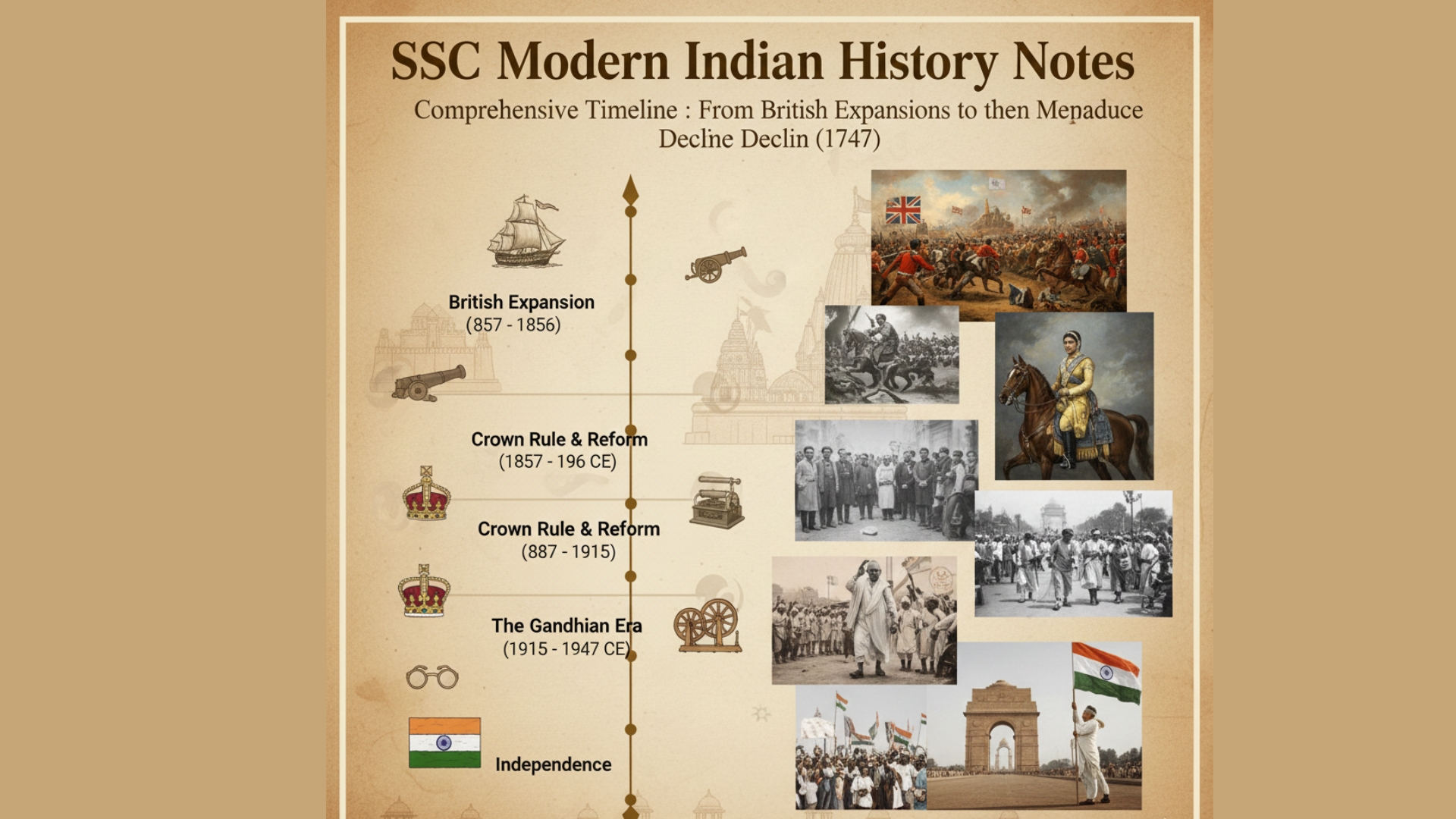
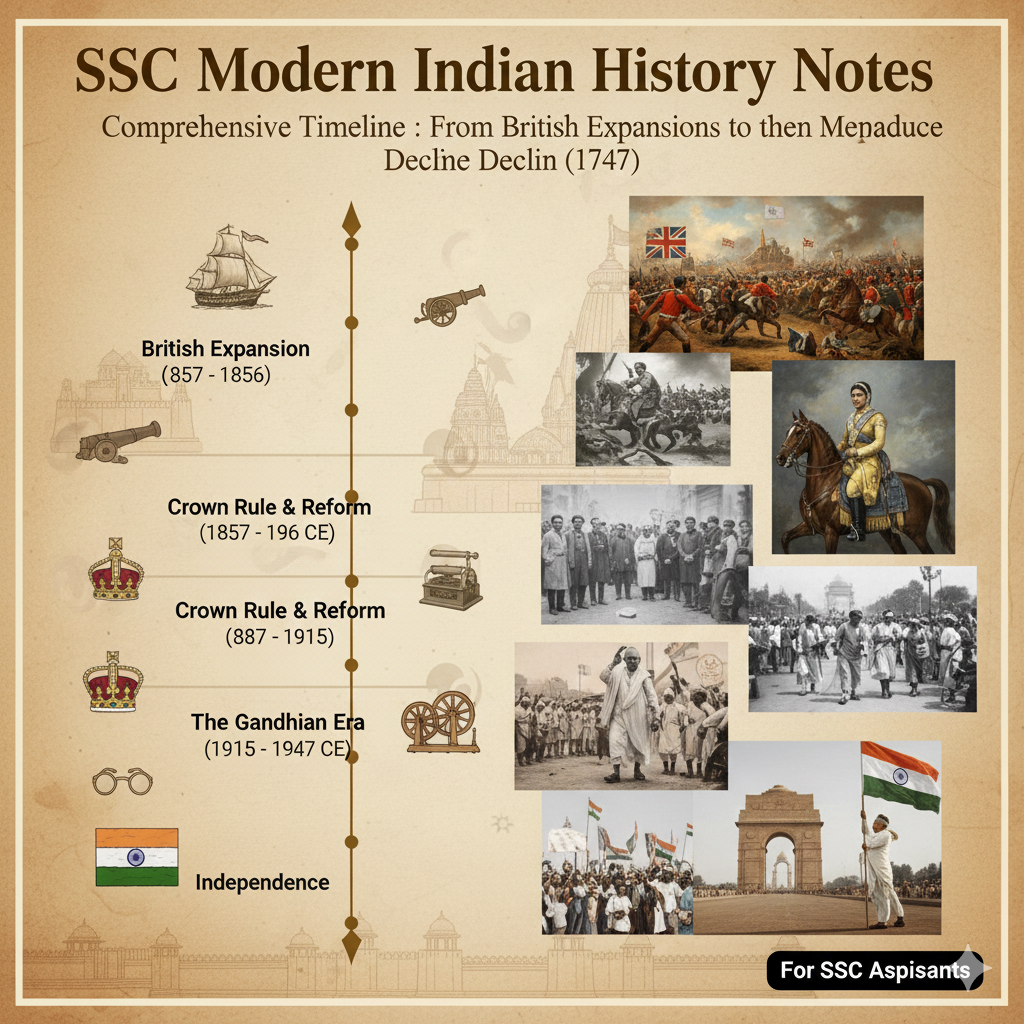
Comprehensive Timeline of Modern Indian History: From British Expansion to Indian Independence (1757–1947)
1. Expansion of British Rule (1757 – 1856)
This phase covers the transition from a trading company (East India Company) to a political power.
-
1757: Battle of Plassey – Robert Clive defeats Siraj-ud-Daulah; marks the start of British political rule.
-
1764: Battle of Buxar – British defeat the combined forces of Mir Qasim, Shuja-ud-Daulah, and Shah Alam II.
-
1765: Treaty of Allahabad – The Company gets 'Diwani' rights (tax collection) for Bengal, Bihar, and Odisha.
-
1773: Regulating Act – First step by the British Parliament to control the Company's affairs.
-
1793: Permanent Settlement introduced in Bengal by Lord Cornwallis.
-
1829: Prohibition of Sati by Lord William Bentinck.
-
1853: First Railway line opened between Bombay and Thane; first Telegraph line in Calcutta.
2. The First War of Independence & Crown Rule (1857 – 1885)
-
1857: The Revolt of 1857 begins at Meerut (led by Mangal Pandey at Barrackpore earlier).
-
1858: Government of India Act 1858 – Company rule ends; India comes under the direct control of the British Crown.
-
1878: Vernacular Press Act passed by Lord Lytton to restrict Indian languages newspapers.
-
1885: Formation of the Indian National Congress (INC) by A.O. Hume. First session held in Bombay (President: W.C. Bonnerjee).
3. Moderate & Extremist Phases (1885 – 1915)
-
1905: Partition of Bengal by Lord Curzon; start of the Swadeshi Movement.
-
1906: Formation of the All India Muslim League at Dhaka.
-
1907: Surat Split – INC divides into Moderates and Extremists.
-
1909: Morley-Minto Reforms – Introduction of separate electorates for Muslims.
-
1911: Delhi Durbar – Partition of Bengal cancelled; Capital shifted from Calcutta to Delhi.
4. The Gandhian Era (1915 – 1947)
-
1915: Mahatma Gandhi returns to India from South Africa (9th January - Pravasi Bharatiya Divas).
-
1917: Champaran Satyagraha – Gandhi’s first civil disobedience in India.
-
1919: Rowlatt Act, Jallianwala Bagh Massacre (13th April), and Montagu-Chelmsford Reforms.
-
1920 – 1922: Non-Cooperation Movement and Khilafat Movement. Ends due to Chauri Chaura incident.
-
1927: Simon Commission arrives (boycotted by Indians).
-
1929: Lahore Session of INC – "Purna Swaraj" (Complete Independence) resolution passed.
-
1930: Civil Disobedience Movement begins with the Dandi March (Salt Satyagraha).
-
1931: Gandhi-Irwin Pact and Second Round Table Conference.
-
1935: Government of India Act 1935 – Basis for the future Indian Constitution.
-
1940: August Offer and the Lahore Resolution (Demand for Pakistan).
-
1942: Quit India Movement launched (8th August) with the slogan "Do or Die".
-
1946: Cabinet Mission Plan and formation of the Interim Government.
-
1947: Mountbatten Plan (June 3 Plan) and Indian Independence Act.
-
15 August 1947: India achieves Independence.