
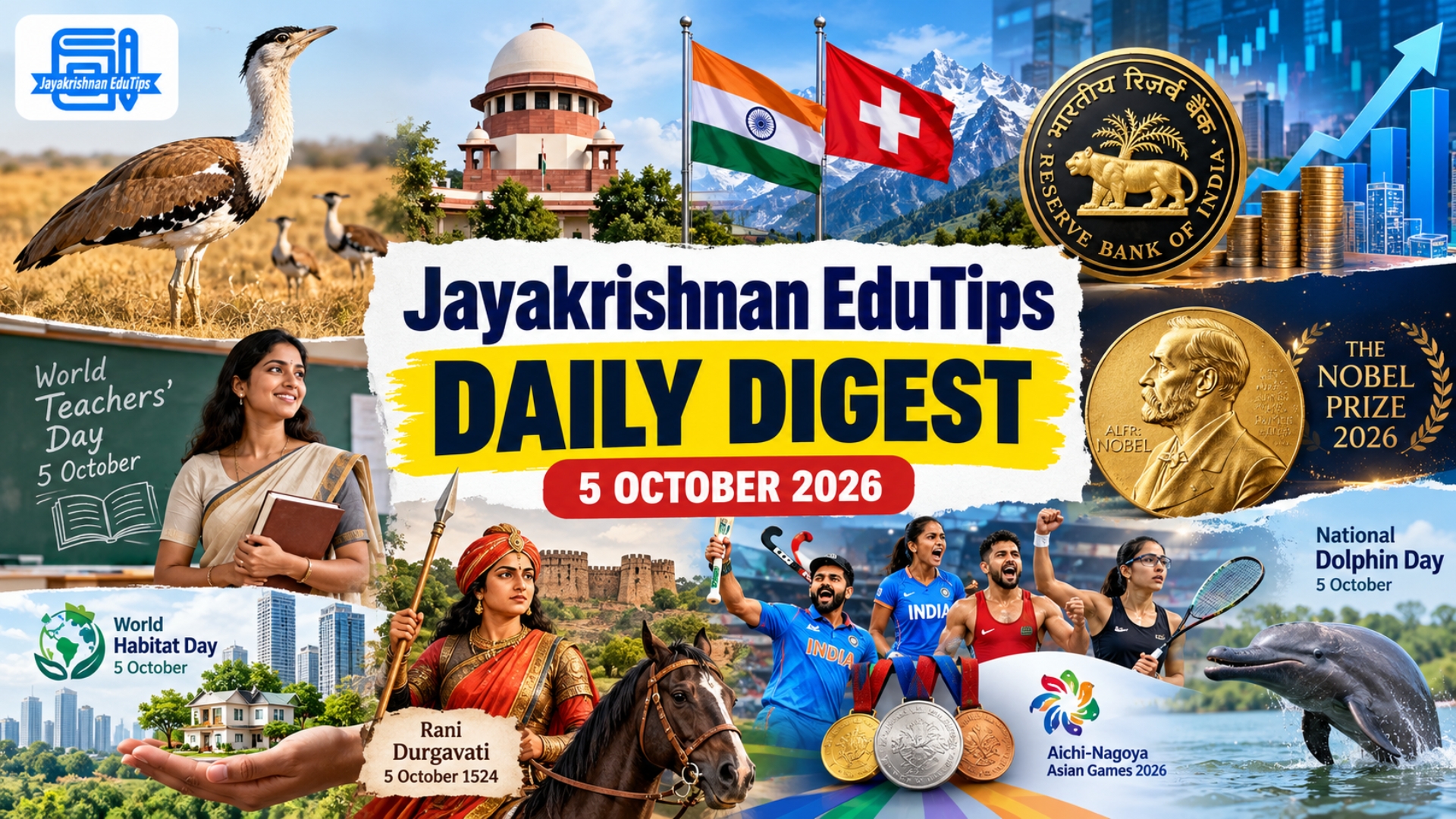
National
The Great Indian Bustard (GIB) conservation programme reached a major milestone with the planned release of two captive-bred male Great Indian Bustards into the wild at Desert National Park, Jaisalmer, Rajasthan.
The Great Indian Bustard is classified as Critically Endangered and is mainly found in the grassland and arid ecosystems of Rajasthan and Gujarat.
The GIB conservation programme involves captive breeding, habitat protection and efforts to reintroduce captive-bred birds into the wild.
The conservation-breeding facilities at Sam and Ramdevra in Jaisalmer currently house 97 Great Indian Bustards.
The programme recorded 24 live GIB chicks in 2025 and 29 live chicks in 2026 through captive breeding.
A scientific “jumpstart” approach has also been used in GIB conservation, including placing captive-laid eggs in wild nests to encourage successful hatching.
More than 2.42 lakh Special Gram Sabhas were scheduled across India as part of the People’s Plan Campaign 2026-27 – “Sabki Yojana, Sabka Vikas.”
Under the campaign, Panchayats will prepare Panchayat Development Plans for 2027-28 through participatory planning.
More than 2.55 lakh Gram Panchayats are participating in the preparation of evidence-based and participatory development plans.
Swiss President Guy Parmelin begins a three-day State visit to India from 5 to 7 October 2026.
India and Switzerland are expected to discuss trade, investment, science and technology, mobility and economic cooperation during the visit.
India and Canada have begun the fifth round of negotiations for a proposed trade agreement.
The Union Education Ministry is planning to establish five Centres of Excellence for classical Indian languages to promote research, preservation and wider understanding of India's linguistic heritage.
The Supreme Court is hearing important petitions concerning the administrative functioning of the Election Commission of India and electoral administration.
International
The 2026 Nobel Prize announcement season begins on 5 October 2026 with the announcement of the Nobel Prize in Physiology or Medicine.
The Nobel Prize announcements will continue throughout the week, covering Physics, Chemistry, Literature, Peace and Economic Sciences.
German Chancellor Friedrich Merz visited Kyiv amid continuing developments in the Russia-Ukraine conflict.
The Russia-Ukraine conflict continues to have major consequences for European security, energy markets and global geopolitics.
Continuing tensions in the Middle East are affecting global energy markets and crude-oil prices.
Rising geopolitical tensions have contributed to increased concerns over global energy security and inflation.
Political and security developments in regions including Tigray in Ethiopia and Bosnia and Herzegovina continue to attract international attention.
Brazil is preparing for an important presidential election, making the country's political developments significant for international observers.
Global crude-oil prices have remained elevated amid geopolitical tensions and concerns over supply.
Economy
The Reserve Bank of India's Monetary Policy Committee meeting begins on 5 October 2026.
The RBI's monetary policy decision is scheduled for 7 October 2026.
The repo rate currently stands at 5.25%.
The RBI's October policy meeting is being closely watched because of inflationary pressures, crude-oil prices, global monetary conditions and economic growth.
India's real GDP grew by 7.8% in the first quarter of FY 2026-27.
India's average annual economic growth during 2021-22 to 2025-26 was around 7.9%.
India's fiscal deficit has declined significantly from around 9.2% of GDP several years ago to a budgeted 4.3% of GDP for the current year.
India's foreign-exchange reserves stood at approximately $747.56 billion in the week ended 25 September 2026.
Foreign Portfolio Investors recorded significant selling in Indian equities during September, putting pressure on domestic financial markets.
Brent crude oil remained above the $100-per-barrel level amid geopolitical tensions and supply concerns.
Rising crude-oil prices are particularly important for India because the country is a major crude-oil importer.
SEBI is reviewing reforms concerning the Closing Auction Session, market timings and settlement methodologies for derivative contracts.
India's banking sector continues to show improvement, with non-performing assets (NPAs) at multi-decadal lows.
Digital payments, GST, financial-sector reforms and financial inclusion continue to be important pillars of India's economic growth.
Strengthening corporate bond markets, pension and insurance markets, green finance and human capital is considered important for India's next phase of economic development.
Date’s Importance – 5 October
World Teachers’ Day is observed every year on 5 October.
World Teachers’ Day commemorates the adoption of the 1966 ILO/UNESCO Recommendation concerning the Status of Teachers.
2026 marks the 60th anniversary of the 1966 Recommendation.
The day highlights the importance of teachers, quality education, professional development and better working conditions for educators.
The global education sector continues to face a significant teacher shortage, making teacher recruitment, training and retention major international priorities.
World Habitat Day is observed on the first Monday of October every year.
In 2026, World Habitat Day falls on 5 October.
World Habitat Day focuses on adequate housing, sustainable human settlements and the future of urban development.
Rani Durgavati was born on 5 October 1524 and is remembered as an important woman ruler in Indian history.
Lord Cornwallis, the second Governor-General of British India, died on 5 October 1805 at Ghazipur.
Person of the Day – Rani Durgavati
Rani Durgavati was born on 5 October 1524.
She became the ruler of Gondwana and is remembered for her courage, administrative abilities and resistance against Mughal expansion.
She fought against the Mughal forces led by Asaf Khan.
Rani Durgavati is regarded as one of the prominent women rulers of medieval Indian history.
5 October 2026 marks her 502nd birth anniversary.
Sports
The Aichi-Nagoya Asian Games 2026 concluded in Japan.
India finished fourth in the medal table with 85 medals.
India's medal tally consisted of 21 gold, 27 silver and 37 bronze medals.
India recorded major successes in cricket, hockey, wrestling, archery and golf.
India won the men's cricket gold medal after defeating Pakistan.
India's women's hockey team won gold, ending a 44-year wait for an Asian Games gold medal in the event.
Aman Sehrawat won gold in wrestling at the Asian Games.
Anahat Singh won a historic women's singles squash silver medal for India.
India secured its first Asian Games medals in disciplines including Mixed Martial Arts and Soft Tennis.
Neeru Dhanda carried the Indian flag at the Asian Games closing ceremony.
In football, Brazil defeated India 4–0 in an international friendly at Kolkata's Salt Lake Stadium.
Awards
The 2026 Nobel Prize announcement week begins on 5 October with the Nobel Prize in Physiology or Medicine.
The Nobel Prize in Physics is scheduled to be announced on 6 October 2026.
The Nobel Prize in Chemistry is scheduled to be announced on 7 October 2026.
The Nobel Prize announcements continue with Literature, Peace and Economic Sciences during the same week.
The Nobel Prize award ceremonies are traditionally held on 10 December, the death anniversary of Alfred Nobel.
Other Important Significance
National Dolphin Day is observed in India on 5 October.
National Dolphin Day focuses particularly on the conservation of the Ganges River Dolphin, India's National Aquatic Animal.
The Ganges River Dolphin is an endangered freshwater cetacean and an important indicator of river ecosystem health.
India's Great Indian Bustard conservation programme has entered a new phase, moving from conservation breeding towards rewilding and reintroduction into natural habitats.
Desert National Park in Rajasthan remains one of the most important habitats for the Great Indian Bustard.
Around 200 sq. km of fenced grassland enclosures have been established inside the Desert National Park to support GIB breeding and conservation.
The Kautilya Economic Conclave 2026 is being held in New Delhi from 3 to 5 October 2026.
The theme of the Kautilya Economic Conclave 2026 is “Resilience in an Age of Flux.”
Discussions at the conclave focus on economic resilience, global uncertainty and India's long-term growth strategy.
India's economic strategy is increasingly focused on achieving sustainable, resilient and inclusive long-term growth.