
Public Sector Banks (PSBs) in India
1. Introduction and Definition
Definition: Public Sector Banks (PSBs) are government-owned commercial banks in India where the majority stake (i.e., more than 50% or minimum 51%) is held by the Ministry of Finance, Government of India, or the State Ministry of Finance.
Regulation: All PSBs function under the regulatory supervision of the Reserve Bank of India (RBI), while ownership and policy matters are overseen by the Department of Financial Services under the Ministry of Finance.
Primary Objective: Unlike private banks that focus primarily on profitability, PSBs operate with the primary objective of social welfare, financial inclusion, and economic development.
2. Historical Background and Nationalisation
Imperial Bank of India (1921): Formed by amalgamating three presidency banks (Bank of Bengal, Bank of Bombay, and Bank of Madras).
Creation of SBI (1955): The Imperial Bank of India was nationalised and renamed the State Bank of India (SBI) on July 1, 1955, following the recommendation of the Gorewala Committee. In 1959, seven regional banks became its subsidiaries.
First Phase of Nationalisation (1969): On July 19, 1969, the Indira Gandhi-led government nationalised 14 major commercial banks that had deposits of over ₹50 crores.
Second Phase of Nationalisation (1980): Six more commercial banks with deposits of over ₹200 crores were nationalised, bringing the total number of nationalised banks to 20.
3. Consolidation and Mega Mergers
To create globally competitive banks and improve operational efficiency, the Government of India initiated a massive consolidation phase.
2017 (SBI Merger): Five associate banks of SBI (State Bank of Bikaner & Jaipur, State Bank of Hyderabad, State Bank of Mysore, State Bank of Patiala, State Bank of Travancore) and the Bharatiya Mahila Bank were merged with SBI.
2019: Vijaya Bank and Dena Bank were merged into Bank of Baroda.
2020 (Mega Merger): Effective from April 1, 2020, several banks were consolidated:
Oriental Bank of Commerce and United Bank of India merged into Punjab National Bank.
Syndicate Bank merged into Canara Bank.
Andhra Bank and Corporation Bank merged into Union Bank of India.
Allahabad Bank merged into Indian Bank.
4. Current List of Public Sector Banks (As of 2026)
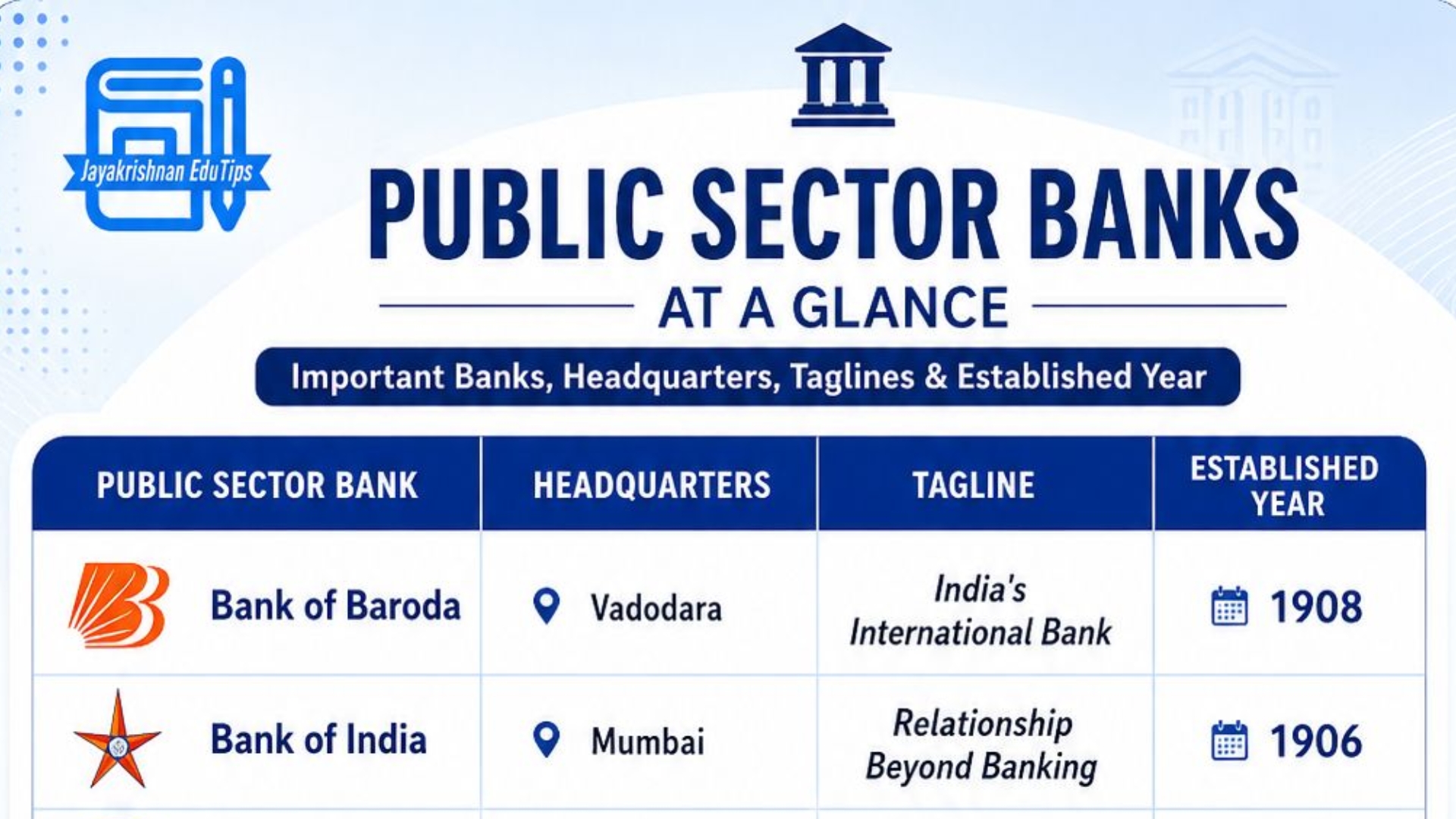
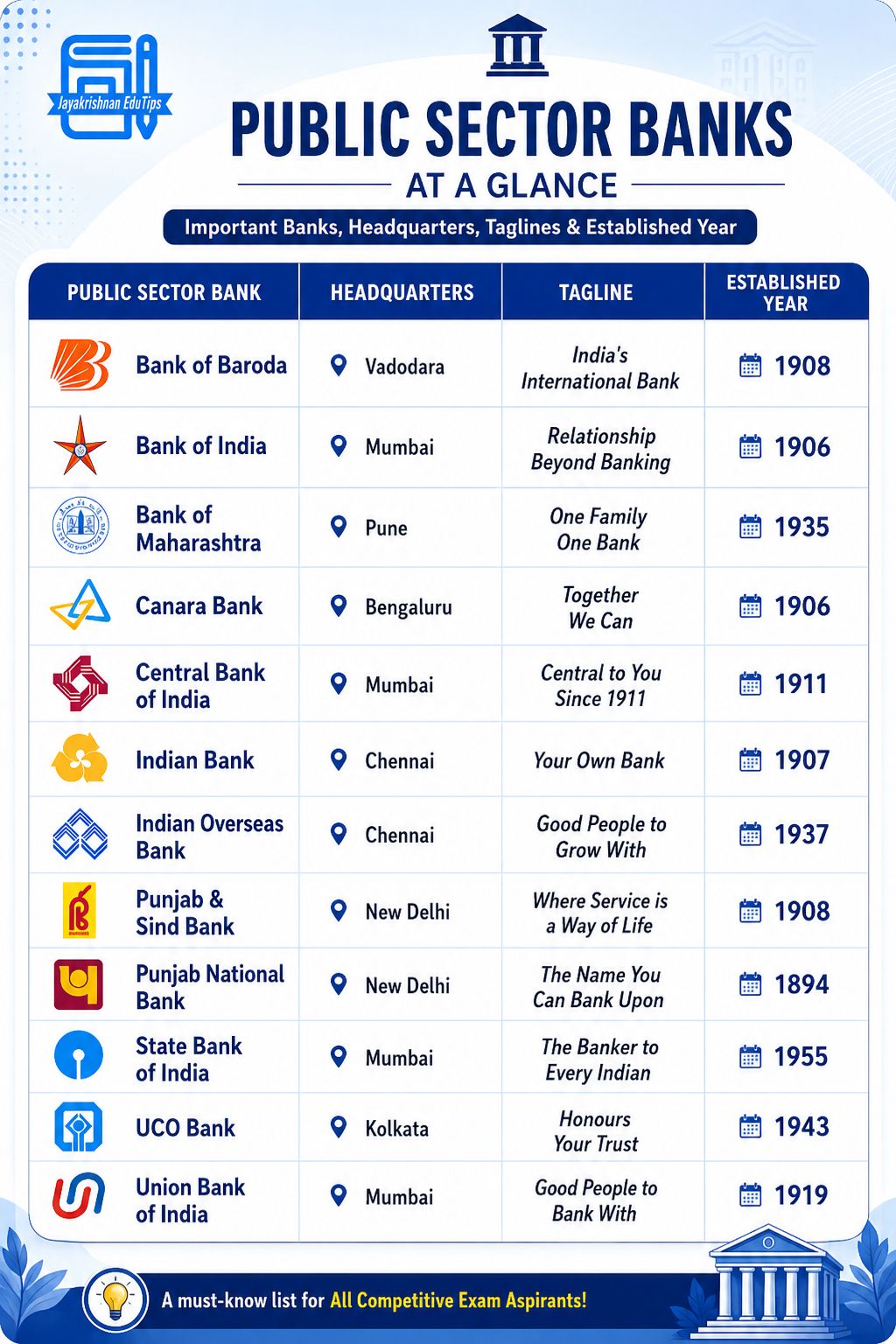
Currently, there are 12 Public Sector Banks operating in India.
Sl. No. | Name of the Bank | Headquarters |
1 | State Bank of India (SBI) | Mumbai, Maharashtra |
2 | Punjab National Bank (PNB) | New Delhi |
3 | Bank of Baroda (BoB) | Vadodara, Gujarat |
4 | Canara Bank | Bengaluru, Karnataka |
5 | Union Bank of India | Mumbai, Maharashtra |
6 | Bank of India (BoI) | Mumbai, Maharashtra |
7 | Indian Bank | Chennai, Tamil Nadu |
8 | Central Bank of India | Mumbai, Maharashtra |
9 | Indian Overseas Bank (IOB) | Chennai, Tamil Nadu |
10 | UCO Bank | Kolkata, West Bengal |
11 | Bank of Maharashtra | Pune, Maharashtra |
12 | Punjab & Sind Bank | New Delhi |
5. Key Roles and Functions
Financial Inclusion: Extending banking services to unbanked and rural areas (e.g., zero-balance accounts under Pradhan Mantri Jan Dhan Yojana - PMJDY).
Priority Sector Lending (PSL): Mandated by RBI to allocate a specific portion of their lending to crucial sectors like agriculture, Micro, Small and Medium Enterprises (MSMEs), education, and housing.
Implementation of Government Schemes: Serving as the primary delivery mechanism for welfare programmes, including Direct Benefit Transfer (DBT), PM Kisan Samman Nidhi, Pradhan Mantri Mudra Yojana, and PM Suraksha Bima Yojana.
Credit Delivery and Savings Mobilisation: Encouraging the habit of saving among the masses and providing affordable credit for infrastructure, industry, and retail customers.
6. Major Challenges Faced by PSBs
Non-Performing Assets (NPAs): Historically high levels of bad loans affect profitability and capital adequacy.
Intense Competition: Tough competition from tech-savvy Private Sector Banks and Non-Banking Financial Companies (NBFCs) offering faster services.
Capital Adequacy: Frequent need for capital infusion from the government to meet Basel III norms.
Technological Lag: Though improving, they often face challenges in upgrading legacy IT systems at the same pace as private counterparts.
7. Important Points for Competitive Exams
Largest PSB in India: State Bank of India (SBI).
First Bank to open a branch outside India: Bank of India (in London, 1946).
Bank with the maximum number of overseas branches: State Bank of India.
Oldest Joint Stock Bank in India: Allahabad Bank (now merged with Indian Bank).
First wholly Indian Bank: Punjab National Bank (established in 1894 in Lahore).