
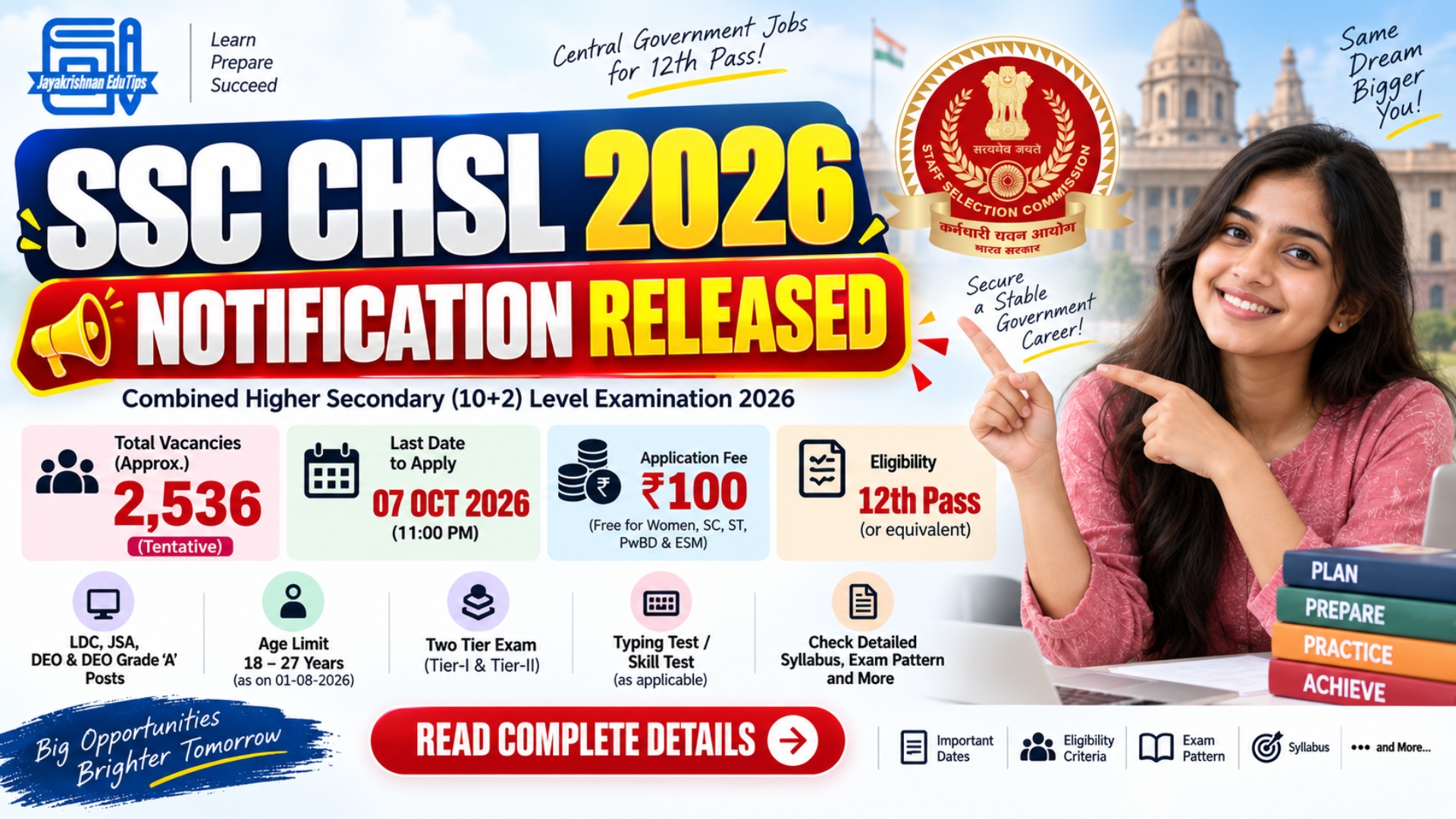
The Staff Selection Commission (SSC) has released the SSC Combined Higher Secondary (10+2) Level Examination 2026 notification on September 7, 2026. The examination is conducted for recruitment to various Group C posts, including Lower Divisional Clerk (LDC), Junior Secretariat Assistant (JSA), Data Entry Operator (DEO) and Data Entry Operator Grade ‘A’ in various Ministries, Departments and Offices of the Government of India.
According to the official notification, approximately 2,536 tentative vacancies have been announced for SSC CHSL 2026. The final number of vacancies will be confirmed later by the concerned user departments.
Candidates who have passed Class 12 or an equivalent examination and meet the prescribed age and other eligibility requirements can apply for SSC CHSL 2026.
SSC CHSL 2026 – Overview
The SSC CHSL 2026 recruitment is an important opportunity for candidates looking for Central Government jobs after completing higher secondary education.
The recruitment examination will be conducted in two tiers – Tier-I and Tier-II. Both tiers will be conducted in Computer Based Examination mode. The final selection will be based on performance in Tier-II, subject to qualifying the mandatory sections and skill/typing test requirements.
The major posts covered under SSC CHSL 2026 are:
Lower Divisional Clerk (LDC)
Junior Secretariat Assistant (JSA)
Data Entry Operator (DEO)
Data Entry Operator Grade ‘A’
SSC CHSL 2026 Important Dates
The online application process has started on September 7, 2026.
The important dates mentioned in the notification are:
Notification Date: September 7, 2026
Starting Date for Online Application: September 7, 2026
Last Date to Apply Online: October 7, 2026
Last Date for Online Fee Payment: October 8, 2026
Application Correction Window: October 14 to October 16, 2026
Last Time for Correction: October 16, 2026, 11:00 PM
SSC CHSL Tier-I Exam: To be notified later
SSC CHSL Tier-II Exam: To be notified later
Candidates are advised not to wait until the final date to submit their applications because heavy traffic on the SSC website can cause technical difficulties.
SSC CHSL 2026 Vacancy
SSC has announced approximately 2,536 tentative vacancies for CHSL 2026.
It is important to note that 2,536 is only the tentative vacancy figure. The final number of vacancies will be determined later after the Commission receives and scrutinizes vacancy details from the participating Ministries, Departments and Organizations.
The SSC will subsequently publish updated vacancy details, including post-wise and category-wise vacancies, on its website.
The notification also clarifies that SSC does not collect state-wise or zone-wise vacancy details.
Therefore, candidates should not consider 2,536 as the final vacancy figure.
Posts Available Through SSC CHSL 2026
SSC CHSL 2026 is being conducted for recruitment to the following major posts:
1. Lower Divisional Clerk (LDC)
The LDC post carries Pay Level-2, with a pay scale of ₹19,900 to ₹63,200.
2. Junior Secretariat Assistant (JSA)
JSA is also placed under Pay Level-2, with a pay scale of ₹19,900 to ₹63,200.
3. Data Entry Operator (DEO)
DEO posts are available in different departments at:
Pay Level-4: ₹25,500 to ₹81,100
Pay Level-5: ₹29,200 to ₹92,300
4. Data Entry Operator Grade ‘A’
DEO Grade ‘A’ carries Pay Level-4, with a pay scale of ₹25,500 to ₹81,100.
The exact department and post allotted to a candidate will depend on merit, post preference and availability of vacancies.
SSC CHSL 2026 Educational Qualification
The minimum educational qualification for most SSC CHSL posts is 12th Standard pass or equivalent from a recognized Board or University.
However, there is an important additional requirement for certain DEO/DEO Grade ‘A’ posts.
For LDC/JSA
Candidates must have passed 12th Standard or equivalent examination from a recognized Board or University.
For DEO/DEO Grade ‘A’
For DEO/DEO Grade ‘A’ posts in the Ministry of Consumer Affairs, Food & Public Distribution, Staff Selection Commission and Ministry of Culture, candidates must have passed:
12th Standard in Science stream with Mathematics as a subject from a recognized Board or equivalent.
For other DEO/DEO Grade ‘A’ posts, candidates must have passed 12th Standard or equivalent.
Candidates who are appearing for their Class 12 examination can also apply. However, they must possess the required educational qualification on or before October 7, 2026.
The result of the qualifying examination must also have been declared by the Board/University by the cut-off date. Merely having the result under processing on the cut-off date will not satisfy the educational qualification requirement.
SSC CHSL 2026 Age Limit
The age limit for SSC CHSL 2026 is:
18 to 27 years
The crucial date for determining age is August 1, 2026.
Candidates must have been born:
Not before August 2, 1999 and not later than August 1, 2008.
Age Relaxation
Relaxation in the upper age limit is available to eligible reserved and other categories as per Government of India rules.
The major relaxations are:
SC/ST: 5 years
OBC: 3 years
PwBD: 10 years
PwBD (OBC): 13 years
PwBD (SC/ST): 15 years
Ex-Servicemen: 3 years after deduction of military service from actual age
Certain Defence Personnel disabled during operations: 3 years
Such Defence Personnel belonging to SC/ST: 8 years
Central Government Civilian Employees: Up to 40 years, subject to conditions
Central Government Civilian Employees belonging to SC/ST: Up to 45 years
Widows/Divorced Women/Women judicially separated and not remarried: Up to 35 years
Such women belonging to SC/ST: Up to 40 years
SSC CHSL 2026 Nationality
A candidate must satisfy the nationality/citizenship conditions prescribed by SSC.
A candidate must generally be:
A citizen of India; or
A subject of Nepal; or
A subject of Bhutan; or
A person of Indian origin who has migrated from specified countries with the intention of permanently settling in India.
Candidates belonging to certain categories other than Indian citizens must possess the required eligibility certificate issued by the Government of India.
SSC CHSL 2026 Application Fee
The application fee for SSC CHSL 2026 is:
₹100
The following candidates are exempted from paying the application fee:
Women candidates
SC candidates
ST candidates
Persons with Benchmark Disabilities (PwBD)
Eligible Ex-Servicemen (ESM)
The fee can be paid online through BHIM UPI, Net Banking, Visa, MasterCard, Maestro or RuPay Debit Card.
The last date for online fee payment is October 8, 2026, up to 11:00 PM.
SSC CHSL 2026 Application Correction
SSC will provide a correction window from:
October 14 to October 16, 2026
Candidates who have successfully submitted their applications and paid the applicable fee will be allowed to make corrections.
A candidate can submit a corrected application up to two times.
The correction charges are:
First correction: ₹200
Second correction: ₹500
The correction charges are applicable to all candidates irrespective of gender or category.
Candidates should therefore check every detail carefully before submitting the application.
How to Apply for SSC CHSL 2026
Applications must be submitted online through the new SSC website or through the mySSC mobile application.
Candidates who have not created a One-Time Registration (OTR) on the new SSC website must first complete the OTR process.
An OTR created on the old SSC website will not be functional on the new website. Once a candidate creates an OTR on the new website, it will remain valid for future examinations conducted through that website.
Basic application process
Complete One-Time Registration on the new SSC platform.
Log in using the registered credentials.
Select SSC CHSL 2026.
Enter the required personal and educational details.
Select examination centres.
Select the required typing-test medium where applicable.
Upload/complete the required photograph and signature requirements.
Pay the application fee, if applicable.
Preview the application carefully.
Submit the application.
Save/print the submitted application for future reference.
SSC has also provided a live photograph capture facility in the application module. Candidates are required to follow the prescribed instructions while capturing their photograph.
SSC CHSL 2026 Exam Pattern
SSC CHSL 2026 will be conducted in two tiers:
Tier-I
Tier-II
Both are Computer Based Examinations.
SSC CHSL Tier-I Exam Pattern
Tier-I consists of four sections:
English Language
25 questions
50 marks
General Intelligence
25 questions
50 marks
Quantitative Aptitude
25 questions
50 marks
General Awareness
25 questions
50 marks
Thus, Tier-I consists of:
100 questions for 200 marks
The total duration is 60 minutes, with a sectional timer of 15 minutes for each subject.
For candidates eligible for the prescribed scribe facility, additional time is provided according to the notification.
Negative Marking in Tier-I
There will be a negative marking of:
0.50 marks for every wrong answer.
SSC CHSL Tier-II Exam Pattern
Tier-II is more extensive than Tier-I and consists of four sections.
Tier-II is conducted in two sessions on the same day.
Session-I
Session-I consists of Section-I, Section-II and Section-III.
Section-I: Mathematical Abilities and Reasoning & General Intelligence
Mathematical Abilities:
30 questions
Reasoning and General Intelligence:
30 questions
Total:
60 questions – 180 marks
The duration is 1 hour, with a sectional timer of 30 minutes for each part.
Section-II: English Language & Comprehension and General Awareness
English Language & Comprehension:
40 questions
General Awareness:
20 questions
Total:
60 questions – 180 marks
The duration is 1 hour, with 40 minutes for English and 20 minutes for General Awareness.
Section-III: Computer Knowledge Test
15 questions
45 marks
15 minutes
The Computer Knowledge Test is mandatory but qualifying in nature.
Therefore, Session-I has a total duration of 2 hours and 15 minutes.
Session-II
Session-II consists of the Skill Test/Typing Test.
The applicable test depends on the post.
DEO/DEO Grade ‘A’ – Skill Test
LDC/JSA – Typing Test
The Skill Test/Typing Test is qualifying in nature.
Negative Marking in SSC CHSL Tier-II
There will be 1 mark negative marking for every wrong answer in:
Section-I
Section-II
Section-III
The Skill Test/Typing Test does not involve objective questions and is qualifying in nature.
SSC CHSL Tier-II Merit Calculation
One of the most important points in the 2026 notification is that the final merit list will be prepared based on the candidate's performance in Section-I and Section-II of Tier-II, subject to qualifying the mandatory qualifying sections.
Section-III, the Computer Knowledge Test, is qualifying.
Section-IV, the Skill Test/Typing Test, is also qualifying.
Candidates must qualify all four sections of Tier-II.
Thus, candidates should not ignore the Computer Knowledge Test or Skill/Typing Test simply because they are qualifying in nature.
SSC CHSL 2026 Skill Test and Typing Test
Skill Test for DEO
For DEO/DEO Grade ‘A’ posts in the departments/ministry specified in the educational qualification section, candidates must achieve a data-entry speed of:
15,000 key depressions per hour
The test duration is 15 minutes, with approximately 3,700–4,000 key depressions in the passage.
For other DEO/DEO Grade ‘A’ posts, the required speed is:
8,000 key depressions per hour
The test duration is again 15 minutes, with approximately 2,000–2,200 key depressions in the passage.
Typing Test for LDC/JSA
Candidates can choose either:
English
Hindi
The choice made in the online application will be treated as final.
The required typing speed is:
English: 35 words per minute
Hindi: 30 words per minute
The typing test will be conducted for 10 minutes.
Candidates choosing Hindi medium for the LDC/JSA typing test must type using Mangal Font.
SSC CHSL 2026 Syllabus
Tier-I English Language Syllabus
The English section includes topics such as:
Spot the Error
Fill in the Blanks
Synonyms
Homonyms
Antonyms
Spellings
Idioms and Phrases
One Word Substitution
Improvement of Sentences
Active and Passive Voice
Direct and Indirect Speech
Shuffling of Sentence Parts
Shuffling of Sentences in a Passage
Cloze Passage
Comprehension Passage
Tier-I General Intelligence Syllabus
The General Intelligence section includes both verbal and non-verbal reasoning.
Important areas include:
Semantic Analogy
Symbolic Operations
Number Analogy
Figural Analogy
Space Orientation
Semantic Classification
Venn Diagrams
Number Classification
Drawing Inferences
Figural Classification
Series
Pattern Folding and Unfolding
Embedded Figures
Critical Thinking
Problem Solving
Emotional Intelligence
Word Building
Social Intelligence
Coding-Decoding
Numerical Operations
Tier-I Quantitative Aptitude Syllabus
The Quantitative Aptitude syllabus includes:
Number System
Whole numbers
Decimals
Fractions
Relationship between numbers
Arithmetic
Percentage
Ratio and Proportion
Square Roots
Average
Simple Interest
Compound Interest
Profit and Loss
Discount
Partnership
Mixture and Alligation
Time and Distance
Time and Work
Algebra
Basic algebraic identities
Elementary surds
Graphs of linear equations
Geometry
Triangles
Centres of triangles
Congruence and similarity
Circles
Chords
Tangents
Angles subtended by chords
Mensuration
Triangle
Quadrilaterals
Regular polygons
Circle
Prism
Cone
Cylinder
Sphere
Hemisphere
Rectangular parallelepiped
Pyramid
Trigonometry
Trigonometric ratios
Complementary angles
Height and distance
Standard identities
Statistical Charts
Histogram
Frequency polygon
Bar diagram
Pie chart
Tier-I General Awareness Syllabus
General Awareness questions are designed to test a candidate's awareness of the environment around them and its application to society.
The syllabus includes current events and areas such as:
History
Culture
Geography
Economic Scene
General Policy
Scientific Research
India and neighbouring countries
Questions may also be based on everyday observation and scientific aspects expected from an educated person.
SSC CHSL Tier-II Syllabus
The Tier-II syllabus broadly covers Mathematical Abilities, Reasoning and General Intelligence, English Language and Comprehension, General Awareness and Computer Knowledge.
Mathematical Abilities
The syllabus includes Number Systems, Arithmetic, Algebra, Geometry, Mensuration, Trigonometry, Statistics and Probability.
In addition to tables and graphs, Tier-II includes measures of central tendency such as:
Mean
Median
Mode
Standard Deviation
It also includes basic probability calculations.
Reasoning and General Intelligence
The syllabus includes verbal and non-verbal reasoning topics such as analogy, classification, series, Venn diagrams, coding-decoding, pattern folding, embedded figures, critical thinking, problem solving, emotional intelligence and social intelligence.
English Language and Comprehension
The section covers:
Vocabulary
Grammar
Sentence Structure
Synonyms
Antonyms
Spot the Error
Fill in the Blanks
Idioms and Phrases
One Word Substitution
Sentence Improvement
Active/Passive Voice
Direct/Indirect Speech
Cloze Passage
Reading Comprehension
The notification states that comprehension may include two or more paragraphs, including a simple passage based on a book/story and another based on a current affairs editorial or report.
General Awareness
The Tier-II General Awareness syllabus covers current events, everyday awareness, scientific aspects, Indian history, culture, geography, economic scene, general policy and scientific research.
Computer Knowledge
Important topics include:
Computer Basics
CPU
Input and Output Devices
Computer Memory
Memory Organization
Backup Devices
Ports
Windows Explorer
Keyboard Shortcuts
Windows Operating System
MS Word
MS Excel
PowerPoint
Internet
Web Browsing and Searching
Downloading and Uploading
E-mail
e-Banking
Networking Devices and Protocols
Cyber Security
Viruses
Worms
Trojan and other security threats
Preventive measures
SSC CHSL 2026 Minimum Qualifying Marks
The notification specifies the following minimum qualifying marks:
UR: 30%
OBC/EWS: 25%
All other categories: 20%
These qualifying requirements apply to Tier-I and Sections I, II and III of Tier-II as specified by SSC.
Candidates should remember that merely achieving the minimum qualifying marks does not guarantee selection. Actual cut-offs can be considerably higher depending on vacancies, competition and post preferences.
SSC CHSL 2026 Selection Process
The selection process can broadly be understood as follows:
Tier-I → Tier-II → Skill/Typing Test → Final Merit & Allocation → Document Verification
Candidates will first be shortlisted for Tier-II based on their performance in Tier-I.
The final merit list will be prepared based on the candidate's overall performance in Tier-II Section-I and Section-II, subject to qualifying the Computer Knowledge Test and Skill/Typing Test.
Post allocation will be based on merit-cum-preference.
Post Preference is Very Important
Candidates should be extremely careful while submitting their post and department preferences.
SSC will collect preferences through an online option form before declaration of the final result/FRTA.
If a candidate does not indicate preference for a particular post or department, he/she will not be considered for that post, irrespective of merit.
Once submitted, the preference is treated as final and irreversible.
Candidates should therefore research the available posts and their specific requirements before submitting their preferences.
SSC CHSL 2026 Examination Centres
Candidates have to select examination centres while filling out the application.
The notification states that candidates must give preference for three examination centres within the same SSC region, in order of priority.
SSC will try to accommodate candidates at their preferred centres, but the Commission reserves the right to add, cancel or change examination centres if required.
For Kerala candidates, examination centres listed under the Karnataka Kerala Region include:
Ernakulam
Kollam
Kottayam
Kozhikode
Thrissur
Thiruvananthapuram
Kannur
Malappuram
Kavaratti is also listed under the KKR region for Lakshadweep.
Aadhaar Authentication and Application Process
SSC has provided Aadhaar-based authentication as an option during the registration/application process.
Candidates who opt for Aadhaar authentication receive certain benefits relating to photograph, identity verification and examination entry requirements.
Candidates who do not undergo Aadhaar-based authentication may need to carry the prescribed photographs and valid original photo identity proof to the examination centre.
Candidates should also ensure that their name, date of birth and other details are entered exactly as required, particularly as reflected in the matriculation certificate.
Document Verification
Document Verification will be conducted by the concerned User Ministries/Departments/Organizations after declaration of the final result.
Candidates may be required to produce original documents including:
Matriculation/Secondary Certificate
Educational Qualification Certificate
Equivalence Certificate, wherever applicable
Caste/Category Certificate
PwBD Certificate, where applicable
Ex-Servicemen documents, where applicable
Age-relaxation certificate, where applicable
No Objection Certificate for candidates already employed in Government/Government undertakings
Failure to substantiate claims made in the application through valid documents can result in cancellation of candidature.
Important Points for SSC CHSL 2026 Candidates
Candidates should keep the following points in mind while applying:
The vacancy figure of 2,536 is tentative and may change.
The age is calculated as on August 1, 2026.
The educational qualification cut-off date is October 7, 2026.
Most posts require 12th pass.
Certain DEO posts require 12th Science with Mathematics.
Tier-I has 100 questions for 200 marks.
Tier-I has 0.50 negative marking for every wrong answer.
Tier-I has a sectional timer.
Tier-II has two sessions on the same day.
Tier-II Sections I, II and III have 1 mark negative marking for each wrong answer.
Computer Knowledge Test is mandatory but qualifying.
Skill/Typing Test is qualifying but mandatory as applicable.
English typing speed required for LDC/JSA is 35 WPM.
Hindi typing speed required for LDC/JSA is 30 WPM.
DEO Skill Test requires 8,000 or 15,000 key depressions per hour, depending on the applicable post.
Post preference is final and cannot subsequently be changed.
Candidates should complete the application well before the last date.
SSC CHSL 2026: Should You Apply?
SSC CHSL is one of the major Central Government recruitment examinations available to candidates with a 10+2 qualification. With approximately 2,536 tentative vacancies, the 2026 examination provides opportunities for candidates seeking positions such as LDC, JSA and DEO.
Candidates who satisfy the educational qualification and age requirements should consider submitting their application within the prescribed deadline. Since the Tier-II examination carries significant importance in the final merit process, candidates should begin preparation for both Tier-I and Tier-II simultaneously rather than waiting for the Tier-I result.
The official notification specifically states that the final selection/FRTA is based on overall Tier-II performance and post preferences, subject to qualifying the required sections and skill/typing test.
SSC CHSL 2026 – Frequently Asked Questions
When was the SSC CHSL 2026 notification released?
The SSC CHSL 2026 notification was released on September 7, 2026.
How many vacancies are announced for SSC CHSL 2026?
SSC has announced approximately 2,536 tentative vacancies. The final vacancy number will be released later.
What is the last date to apply for SSC CHSL 2026?
The last date to submit the online application is October 7, 2026, up to 11:00 PM.
What is the application fee?
The application fee is ₹100. Women, SC, ST, PwBD and eligible ESM candidates are exempted from payment.
What is the age limit for SSC CHSL 2026?
The age limit is 18 to 27 years as on August 1, 2026.
What is the educational qualification?
Candidates must generally have passed 12th Standard or equivalent. Certain DEO/DEO Grade ‘A’ posts require 12th Science with Mathematics.
How many questions are there in SSC CHSL Tier-I?
Tier-I contains 100 questions for 200 marks.
Is there negative marking in SSC CHSL?
Yes. Tier-I has 0.50 marks negative marking per wrong answer, while Tier-II Sections I, II and III have 1 mark negative marking per wrong answer.
Is the SSC CHSL Tier-II Computer Test mandatory?
Yes. The Computer Knowledge Test is mandatory, although it is qualifying in nature.
Is the typing/skill test mandatory?
Yes, the applicable Skill Test/Typing Test is mandatory and qualifying, subject to the exemptions specified in the notification.
Conclusion
The SSC CHSL 2026 recruitment is an important opportunity for 12th-pass candidates seeking Central Government employment. The examination offers posts such as LDC, JSA, DEO and DEO Grade ‘A’, with pay levels ranging from Level-2 to Level-5.
Candidates should carefully check their eligibility, complete the OTR process on the new SSC website and submit the application before October 7, 2026. Since the Tier-II examination plays the decisive role in final merit, aspirants should give equal importance to Tier-II preparation, Computer Knowledge and the applicable Typing/Skill Test.
Note: The examination dates for Tier-I and Tier-II have not yet been announced in the notification and will be communicated separately by SSC.
This article is prepared based on the official SSC CHSL 2026 notification dated September 7, 2026.